Prices as listed by En Route.
The retailer’s price may differ.
Bookstores, parishes, and schools:
Order direct at a discount.
- Subject
- Philosophy
- Series
- A Not-So-Elementary Christian Metaphysics
- Reading lists
- The Catholic Philosophical Tradition
- Formats
- Hardcover, Paperback, Kindle
- ISBN (hardcover)
- 9781633370630
- ISBN (paperback)
- 9781950108671
- Publisher
- En Route Books and Media
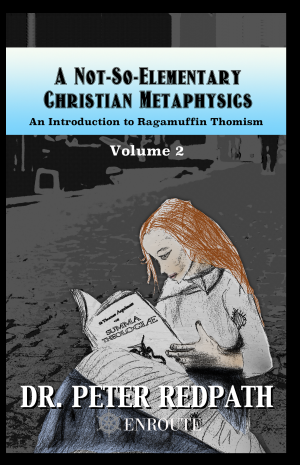
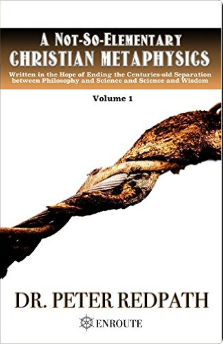
A Not-So-Elementary Christian Metaphysics, Volume 1
Written in the Hope of Ending the Centuries-old Separation between Philosophy and Science and Science and Wisdom
This book’s chief aim is novel and radical: to reunite philosophy, science, and wisdom (which had initially been separated several centuries ago by René Descartes) through a synthesis of two new interpretations, one of the nature of ancient Greek philosophy and science, and, two, of the metaphysical teachings of St. Thomas Aquinas about philosophy and science. Download Chapter 1 of Volume 1 for free and buy the book to read the rest.
On December 11, 2012, Prof. Peter A. Redpath discussed his book A Not-So-Elementary Christian Metaphysics in which he examines the essential connection between philosophy, science, and wisdom, severed with the birth of “modern science.”
- Audio version of the above talk located on the International Etienne Gilson Society Website:
Praise
“A Not-So-Elementary Christian Metaphysics is a rich book, and Redpath has a clear style. He breaks complicated issues into short, intelligible units. He repeats difficult points, and then he repeats them again, rephrasing them to make them understandable. This is a book I wish I’d had in my earlier years of studies. In reading it, I found that many notions and points I had often wondered about, or about which I needed more explanation, were much clearer after Redpath dealt with them. For us metaphysicians, this is a book of refreshment and a review of what we thought we knew….A Not-So-Elementary Christian Metaphysics is one of those rare, to-the-point books that argues forcefully about the heart of things. The book is remarkably whole. It relates the order of the mind and the order of things in a way we seldom see in a brief space. Yes, it remains a difficult book. We must take time to read it….The advantage of this book is its constant, step-by-step guidance to knowing how to achieve such an end of understanding what is, if we would have it. This is the highest service a professor can perform for those who wonder, for those who seek to know reality.”
“Standing on the shoulders of the intellectual principles that he has synthesized from classical thinkers like Plato, Aristotle, and Aquinas and twentieth-century intellectual giants like Mortimer J. Adler, Jacques Maritain, Armand A. Maurer, and Charles Bonaventure Crowley, Redpath has, in the tradition of Adler, composed a monumental work that challenges as false and civilizationally dangerous prevailing opinions of leading philosophical scholars, scientists, and ethicists ‘falsely-so-called’ about the nature and history of the subjects in which they profess to have an expertise.”
“In his book, A Not So Elementary Christian Metaphysics, Dr. Peter Redpath offers insightful analysis as to how modern science came to replace the classical philosophy and theology that had reigned in Western thought prior to the time of Rene Descartes. Redpath points out that no true science is possible without metaphysics first to offer apodictic foundations upon which to build the scientific edifice. Still, Descartes separated science from the world of theology and philosophy, thus starting it on a long historical road that ends in traditional ontological questions about human life, its origin, and destiny being now claimed solely the province of utopian socialists using modern methods of mathematical physics. The author skillfully illuminates the intellectual moves made by modern philosophers that led finally to the abysmal error that traditional religion and philosophy are today considered relics of an ‘infantile past.’ Redpath’s adroit exposure of this twisted intellectual path to modern folly makes for rewarding reading.”
“The power of Redpath’s historical survey and analysis is reminiscent of Hegel at his most sweeping.”
“Within the context of his penetrating review, Redpath gives stunning reinterpretations of Plato, Aristotle, and Aquinas to show that each of them recognized philosophy and science to be mainly studies of the problem of understanding the one and the many. His analysis of Aristotle and St. Thomas’s teaching about the nature of science is revolutionary. Within the process of these reinterpretations, he challenges commonly-received opinions among scholars about the nature and origin of the problem of universals, the nature of analogy and Christian philosophy, and the role that Descartes and Rousseau play in the development of modern thought. He persuasively argues that Rousseau is a neo-Averroist and that Rousseau’s teaching about the ‘General Will’ is simply an analogous transposition to the political sphere of Averroes’s teaching about the unity of the intellect. He even goes so far as to claim that the popular reduction of science to physics and the divorce of science from philosophy and wisdom is a result of the displacement in modern thought of metaphysics by utopian socialism (of various stripes). In short, he radically alters prevailing undertandings of philosophy, science, politics, and their history. In doing so he opens the path to their reunification. To say that this book is groundbreaking is an understatement. It is nothing short of a radical reinterpretation of Western intellectual history. As such, it should be an essential part of any serious scholar’s library.”
“Common sense tells us the mind seeks unity and truth. While the universe is composed of many elements, the universe is nonetheless a universe(meaning one.) Our mind seeks truth in understanding commonality. The Greeks understood that the mind sought wisdom by the integration of reality. The modern age as it evolved to materialism and atheism chose to separate science from philosophy from each other,being dismissive of philosophy since it was intangible. The issue is simple, but scientists and philosophers who are legendary created labyrinthian epistemological systems that bear no semblance to reality. Redpath, being a brilliantly disciplined philosopher with the common sense of a native of Brooklyn, NY cuts through the confusion in a volume that will rock ersatz philosophers!!!”
“Dr. Redpath observes that all science/philosophy ‘chiefly aims at improving human possession of truth’ and adopts Mortimer Adler’s reflection that ‘the relation between truth and error is always that of a one to many. The truth is always singular, while the errors it corrects are manifold’ (p.210). In this work, Dr. Redpath accurately identifies the conditions for knowing the truth and at the same time combats the manifold errors that flow from the modern and postmodern misunderstanding of science/philosophy and attendant separation of science from philosophy. Metaphysical realism unites all the sciences under a final end and is inseparable from them. The principles of metaphysics are common to all the arts and sciences. Tearing down this wall of separation between philosophy and science is a necessary condition for reversing the decay of Western culture. Redpath begins the task.”
“This book is a “must read” for anyone wanting to develop a fine critical thinking on modern Western culture. Dr. Redpath provides a view of the evolution of modern thinking, by looking at the impact that abandoning Christian Metaphysics had on modernity, on current sciences and philosophy. Christian Metaphysics not only has a central role in providing unity to human knowledge, to build wisdom, to integrate sciences, which leads to the integration of the human being and the societies; but more than that, it rediscovers the best of the world, of man, the meaning of life, the road to happiness.”
About the Author

Peter A. Redpath (retired Full Professor of Philosophy at St. John’s University, New York) is author, editor, co-editor of 22 books and many dozens of articles and book reviews. An internationally recognized scholar, since 1980 he has given over 200 invited guest lectures nationally and internationally. Among his many accomplishments, he is CEO of the Aquinas School of Leadership, LLC; former Founder and Chair of the Thomistic Studies Graduate Concentration in Christian Wisdom for Holy Apostles College and Seminary (USA); an Affiliate Scholar with the University Abat Oliba Graduate program (Barcelona, Spain). Peter is also co-founder of the Gilson Society (USA) and the International Etienne Gilson Society, the Adler-Aquinas Institute, and the Angelicum Academy and Great Books Academy homeschool programs (both founded with the help of Mortimer J. Adler); former executive editor of the Value Inquiry Book Series (VIBS) for the Dutch publisher Editions Rodopi, B.V., and special series editor for Rodopi and Brill/Rodopi. Presently, he is a member of the editorial board of Brill Publishing’s Philosophy and Religion (PAR) series, a member of the Advisory Board of the Lyceum Institute, and Officer in Charge of Medieval Christian Philosophy and Academic Liaison to the Holy See for Global Scholarly Publications. For a list of articles published on the Catholic World Report, see http://www.catholicworldreport.com/author/redpath-peter/
One of the books Dr. Redpath has edited and highly endorses is Origin of the Human Species by Dr. Dennis Bonnette. Dr. Bonnette has also written an article on the topic entitled, “The rational credibility of a literal Adam and Eve.” When combined with the article, the book provides a Thomistic interpretation of mainstream evolution theory that is consonant with Catholic teaching, including that regarding our first parents.The article is found in the peer reviewed Spanish philosophical journal, Espiritu. For a list of articles published on the Catholic World Report, see http://www.catholicworldreport.com/author/redpath-peter/
Reviews
- Dr. Raymond Dennehy, International Philosophical Quarterly (Volume 56, Issue 3, September 2016, 381-383) – (click here to read it).
- Fr. James V. Schall, SJ, New Oxford Review (May 2018) – (click here to read it)