
AI Usage Policy for En Route Books and Media
Upholding Creativity, Truth, and Human Dignity in Catholic Publishing
Discover our commitment to integrating AI with respect for human creativity and moral responsibility, ensuring our work reflects Catholic values.
Introduction and Purpose
Why We Adopted an AI Policy
At En Route Books & Media, we recognize artificial intelligence as a powerful product of human ingenuity. Yet, as Pope Leo XIV reminds us, the central question is not what technology can do, but what the human person becomes through its use.
This policy establishes a framework for the responsible use of AI in a manner that:
- safeguards human dignity
- preserves authentic authorship
- promotes truth and intellectual integrity
- supports the mission of Catholic publishing
Through this policy, En Route is stepping boldly into the field of artificial intelligence and will be sharing on this page methods by which it may be responsibly used.
Guiding Principles
-
Human Creativity is Primary
Human beings are co-creators with God. AI may assist, but it cannot replace the uniquely human act of intellectual and spiritual creation.
-
Technology Must Serve the Person
AI must remain subordinate to human judgment, never supplanting discernment, responsibility, or moral agency.
-
Truth is Non-Negotiable
Catholic publishing exists to communicate truth. AI must never distort, fabricate, or obscure it.
-
Discernment Over Automation
The use of AI requires prudence. Not everything that can be automated should be.
-
Relational Integrity
Communication and authorship must remain authentically human, resisting the illusion that machines can substitute for genuine intellectual or spiritual encounter.
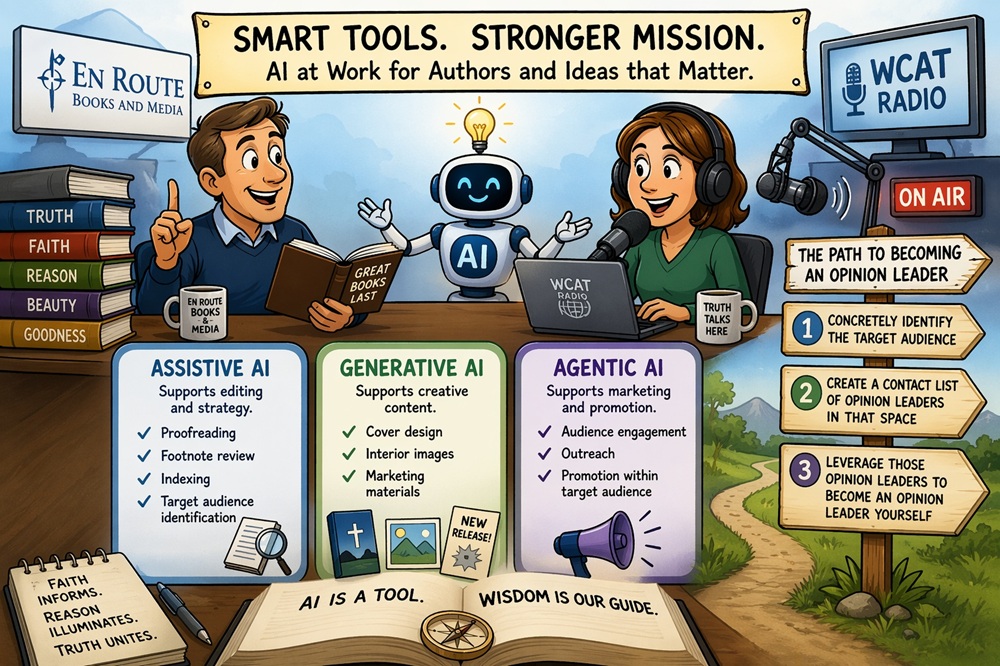
Types of AI Covered in this Policy
Assistive AI
These are tools designed to help with tasks such as editing, grammar correction, formatting, and transcription. They enhance human work without replacing the creative input of the author.
Generative AI
This type of AI can create text, images, or other content. While it can be a valuable aid in brainstorming and drafting, it must not substitute for the original thought and creativity of human authors and artists.
Agentic AI
These systems can act autonomously or semi-autonomously on behalf of users. In Catholic publishing, their use must be carefully monitored to ensure alignment with ethical standards and human dignity.
Permitted Uses of AI
Guidelines for Acceptable AI Use
By adhering to these guidelines, En Route Books and Media ensures that AI serves as a supportive tool, respecting the primacy of human authorship and creativity.
AI may be used in ways that support—but do not replace—human authorship, including:
- Copyediting and grammar refinement
- Formatting and manuscript preparation
- Transcription and summarization
- Research assistance and idea organization
- Brainstorming support
In all cases, the author remains the primary originator of thought, structure, and argument.
Authors must disclose the use of generative AI when:
- AI contributes to drafting or content generation
- AI materially shapes the structure or argument
Disclosure should include:
- Type of AI used
- Nature of its contribution
Routine assistive uses (grammar, formatting) do not require disclosure.
Some Encouragement for Authors Engaging AI
Restricted or Prohibited Uses of AI
AI Use Limitations in Catholic Publishing
Restricted and Prohibited Uses
The following uses are not permitted:
- Presenting AI-generated content as original human authorship. Flag AI where used.
- Delegating substantial portions of writing to generative AI. Choreographing is permissible – simply flag.
- Using AI to produce theological, philosophical, or doctrinal claims without rigorous human verification. Footnoting is necessary.
- Creating content that lacks authentic intellectual engagement with the field of study. An author should be able to be interviewed on the content of his or her book.
- Any use that risks plagiarism, misrepresentation, or erosion of authorial responsibility.
AI must never function as a substitute for the human act of thinking.
Authorship and Originality Standards
At En Route Books and Media, we uphold the sanctity of original human thought and creativity. Authors are expected to maintain primary authorship, ensuring that all submissions are a genuine reflection of their intellectual synthesis and insights. While AI tools may assist in the creative process, they must not replace the unique human contribution that is central to our mission. Our commitment is to foster works that resonate with authentic human experience and divine inspiration.
All works published by En Route must reflect:
- Genuine human authorship
- Original intellectual synthesis
- Personal engagement with truth
As Pope Leo XIV warns, access to data or generated content must not be confused with true intelligence, which involves openness to truth and the good.
Authors are responsible for ensuring that their work reflects authentic human insight, not algorithmic assembly.
Disclosure Requirements
Transparency in AI Usage
Editorial Review and Compliance
Ensuring Integrity and Originality
En Route Books and Media is committed to maintaining the highest standards of originality and integrity in our publications. Our editorial team rigorously reviews each manuscript to ensure it aligns with our values of truth and authenticity. Authors are required to disclose any use of AI in their submissions, detailing the extent of its involvement, whether for editing, drafting, or research assistance. This transparency is crucial to uphold trust and integrity in our publishing process.
Theological Considerations
Creativity and Truth in Catholic Thought
At En Route Books and Media, we believe that human creativity is a profound participation in God’s ongoing act of creation. This belief is rooted in the Catholic understanding that each person is made in the image of God, endowed with the capacity to create and innovate. Our AI Usage Policy reflects this theological foundation, emphasizing that while technology can enhance our creative processes, it must always serve the truth and uphold the dignity of the human person.
Truth is a cornerstone of our mission, guiding our commitment to intellectual integrity and theological fidelity. In a world where information is abundant, discerning truth becomes an essential task. Our policy ensures that AI tools are used to support, not replace, the human pursuit of truth, aligning with our Catholic values and the Church’s teachings.
By grounding our policy in these principles, we aim to foster an environment where technology aids human creativity without overshadowing the divine gift of creation. We invite our authors, editors, and readers to engage with AI in a manner that respects and enhances the sacredness of their creative endeavors.
Ongoing Discernment
Adapting to Technological and Ethical Developments
Recognizing the rapid evolution of AI technologies, En Route Books and Media is committed to regularly reviewing our AI Usage Policy. This ongoing discernment process will be guided by the latest developments in Church teaching and ethical considerations, ensuring that our practices remain aligned with our Catholic mission.
We understand that as AI continues to advance, new challenges and opportunities will arise. Our commitment to staying informed and responsive to these changes is unwavering, as we strive to uphold the highest standards of integrity and responsibility in our publishing efforts.
This policy, therefore, reflects a deeper conviction:
Artificial intelligence is not merely a technical tool but an anthropological challenge—one that touches on human identity, creativity, and responsibility.
We therefore affirm:
- The irreplaceable dignity of the human author
- The moral responsibility of those who communicate truth
- The necessity of maintaining authentic human agency in intellectual work
Conclusion
A Commitment to Our Community
En Route Books & Media embraces technology with courage, clarity, and caution—recognizing both its promise and its limits.
Artificial intelligence may assist the work of publishing, but it can never replace the human vocation to seek, understand, and proclaim the truth.