TESTIMONIALS
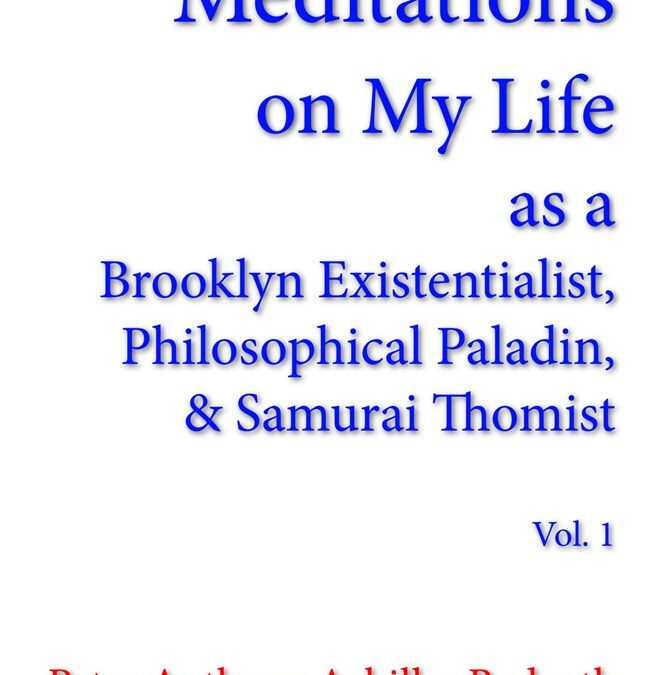
“I’ve been sharing a few of Peter Redpath’s Meditations with several of my undergraduate students. They are delighted to hear of a mobster discovering a new moral insight about his imprudence in having had an adulterous affair with his wife’s best girlfriend. Even gangsters and professional politicians want to be happy. Redpath communicates serious philosophical thought with a light anecdotal tone. Witty, engaging, and delivered in three- or four-page installments, these forty meditations each last one attention-span. Redpath introduces us to some very interesting people—Thomas Aquinas and Carlo Gambino, for example. Even the chapter headings catch our attention: “How ‘Augustinian-Sicilian, Political Prudence’ is an Essential First Principle of the Colorful and Unconventional Behavior of ‘Brooklyn Existentialist’ Friends from My Youth.” This unacademic and funny collection of essays turns out to be philosophically informative and free from stodginess.” – E. M. Macierowski, Benedictine College
“What has Brooklyn to do with Athens? A good deal, it turns out. In this intimate account, Professor Redpath teaches us what philosophy is really all about—and how even the “Wise Guys” he grew up with demonstrated more common sense than Descartes, Rousseau, Kant, or Hegel.” – Eduardo Bernot, Holy Apostles College and Seminary, Aquinas School of Leadership
“In weaving together his personal biography with his intellectual development, Peter Redpath offers a colorful blend of inimitable characters and philosophical meditations, which led him to define himself as a Brooklyn Existentialist, a Philosophical Paladin and a Samurai Thomist. Growing up in Dyker Heights, Brooklyn, Redpath interacted with a ‘rogues gallery’ of Cosa Nostra figures, some lovable and others deadly. It was there that he first learned the uncommon common sense of Brooklyn Existentialism, which matured into his practice of philosophy as a Paladin – one who battles for an honorable cause – and as a Samurai Thomist, a member of a professional class of noble fighters after the fashion of St. Thomas Aquinas. Redpath’s Thomism is unconventionally scholastic as it focuses on organizational psychology and leadership, aiming to elucidate what is genuinely good leadership, so rare in today’s politicized, declining culture. This autobiography confirms that Redpath’s career is truly that of a noble, patriotic, and hopeful ‘knight without armor in a savage land.’” – Tom Michaud, Retired Dean of School of Professional Studies, West Liberty University, Wheeling, West Virginia, and author of After Justice: Catholic Challenges to Progressive Culture, Politics, Economics and Education
“Cleverly presented for widespread readership as a short series of wise and witty musings about the nature of philosophy by a street-smart cultural critic like Eric Hoffer, Peter Redpath’s Autobiography is much more than this. Calling upon his early childhood Brooklyn upbringing surrounded by organized crime bosses and their children (who were personal friends of his and his family) from whom he acquired many philosophical truths in the form of practical and productive common sense, Redpath extends his reflections to subsequent, philosophical truths he learned from lifelong experience working with students and colleagues ranging from sociopaths to saints. Doing this causes him completely to reinterpret the nature and history of philosophy and every species of higher learning whenever and wherever it exists. By nature, wherever and whenever they live, Redpath argues all somewhat psychologically healthy human beings are convinced that: (1) their lives are providentially guided by a prudent, commonsense, natural inclination to live a life of perfect virtue—a life of uncommon common sense; (2) all species of higher learning and cultural and civilizational development essentially grow out of this natural desire; (3) if this natural desire disappears from an individual, culture, or civilization that individual, culture, or civilization becomes sociopathic, and commits suicide. Peter Redpath’s Meditations are written in the form of a literary thriller that could easily become a best seller and produce an Oscar-winning movie. The truths they contain constitute a primer about how to survive and thrive in a contemporary world that is increasingly losing its common sense and going mad. For this reason alone, it is well worth reading.” – Dennis Bonnette, Retired Chairman, Philosophy Department, Niagara University, New York, and author of Rational Responses to Skepticism: A Catholic Philosopher Defends Intellectual Foundations for Traditional Belief




 Kiki Latimer is the author of

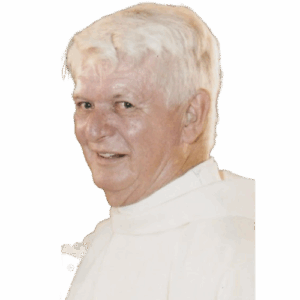 Born in 1938 in Braintree, Massachusetts, John A. “Jack” Sullivan was the son of Dorothy and Arthur Sullivan. He attended public schools, graduating from Braintree High School in 1957, and continued his education at Stonehill College, majoring in government history and philosophy. He pursued graduate studies at Georgetown University in Foreign Service before earning his law degree from Suffolk University Law School in 1967.

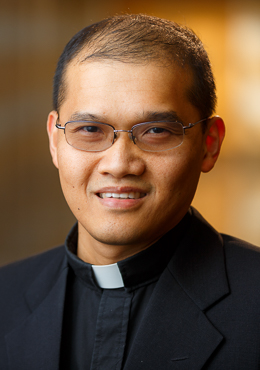
 Peter A. Redpath (retired Full Professor of Philosophy at St. John’s University, New York) is author, editor, co-editor of 22 books and many dozens of articles and book reviews. An internationally recognized scholar, since 1980 he has given over 200 invited guest lectures nationally and internationally. Among his many accomplishments, he is CEO of the Aquinas School of Leadership, LLC; former Founder and Chair of the Thomistic Studies Graduate Concentration in Christian Wisdom for Holy Apostles College and Seminary (USA); an Affiliate Scholar with the University Abat Oliba Graduate program (Barcelona, Spain). Peter is also co-founder of the Gilson Society (USA) and the International Etienne Gilson Society, the Adler-Aquinas Institute, and the Angelicum Academy and Great Books Academy homeschool programs (both founded with the help of Mortimer J. Adler); former executive editor of the Value Inquiry Book Series (VIBS) for the Dutch publisher Editions Rodopi, B.V., and special series editor for Rodopi and Brill/Rodopi. Presently, he is a member of the editorial board of Brill Publishing’s Philosophy and Religion (PAR) series, a member of the Advisory Board of the Lyceum Institute, and Officer in Charge of Medieval Christian Philosophy and Academic Liaison to the Holy See for Global Scholarly Publications. For a list of articles published on the Catholic World Report, see